
- December 27, 2025
- Posted by: Aceget
- Category: Uncategorized
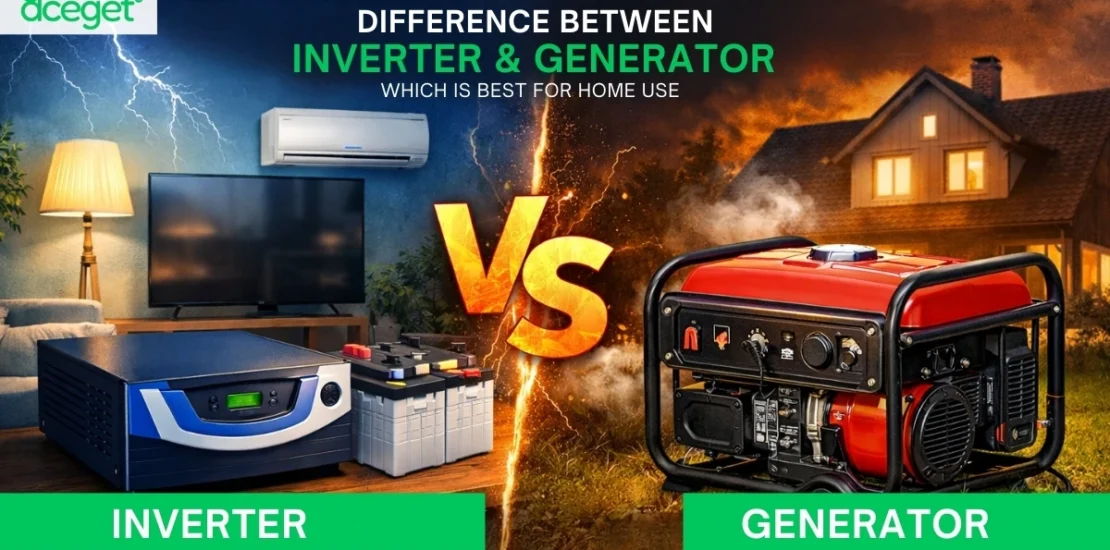
An inverter is a source of clean energy that can be used for everyday uses. Meanwhile, the generator is a heavy power source that can work for a long time without using excessive fuel. When any outrage happens at your home, factory, or weddings. At those crucial moments, you need to use an inverter or generator to meet your requirements. To use these devices, you must know about them and when to use each of them. The use of an inverter or a generator in the wrong situation may lead to disastrous consequences. They take a heavy load of power to work at any significant occasion that helps users to perform their tasks easily.
There is a basic difference between an inverter and a generator, but first of all, you should know what they are. What is the use of an inverter? What is the use of a Generator? What are the main differences between an inverter and a generator?.
Let us talk about the Inverter and a generator to know about them and their main differences in the text. By the end, we will find out which is best for home use. Let us start from here.
Inverter vs Generator
Inverter
What is an Inverter?
An inverter is an automated device that is responsible for converting direct current (DC) into alternating current (AC). The conversion of the current can be done from batteries and solar panels. It works as a power backup system that saves direct current and converts it to supply energy to other devices. This kind of electricity is clean and easy to transfer. It also works in a grid-system. The transistor is a semiconductor device that is used to turn the inverter on and off.
Power switches like MOSFETs and IGBTs steadily switch DC on and off that creates the pulse. The capacitor or inductor controller uses Pulse Width Modulation (PWM) to smooth the width of the pulse that eventually can be used by any device connected.
Use Of An Inverter
There are many uses of an inverter, as stated below. An inverter saves energy in batteries in solar panels, which makes it efficient and clean to be used for a long time. It can be switched on and off many times in the case of outbreaks. The basic uses of an inverter are mostly household-related, and many more.
- It can be used in a solar energy system that converts sunlight into direct energy, and that will be saved in batteries as AC. You can use it to supply energy to the power grids of the houses.
- Vehicles and off-grid systems that are built to use inverters as their main power source. The inverter in the vehicle is used to run inside devices like the radio, transmitters, and the speaker.
- The same principle of the inverter is used in an electric vehicle to convert DC into AC to run the vehicle.
- It is also primarily used as a home backup power to supply power to AC, lights, fans, and TVs, etc.
Generator
What is a generator?
A generator is a machine that is responsible for the conversion of mechanical energy ( kinetic energy is a component of mechanical energy) to electrical energy. It uses electromagnetic induction that moves across the magnetic field to form current pulses. People use it to power business sources or places where heavy power is required. The mechanical power is generated through engines and turbines, either AC or DC power, which is saved in the generator. It can be used in any kind of power grid this way.
Two types of generators are used:
- Alternators (AC generator): It produces the alternating current that reverses its direction. It is mainly used to charge the battery of a vehicle. The rotating power of the rotor is used to supply current to home generators.
- Dynamos (DC generator): The commutator is used to allow current to flow in one direction, which creates DC pulses. It is complex and less efficient that makes it good for only small power supplies.
Use Of A Generator
- It is used in off-grid living and remote construction.
- Farmers use it to run irrigation systems, barns, and machines for farming purposes
- They supply power essential for mining and manufacturing
- Generators can also be used in transportation, like boats, aircrafts and ships.
Generators are used for multiple uses, but they run on a heavy power source. It also comes with disadvantages like safety hazards, environmental pollution, and fuel consumption. Even after all these negatives, it is still used in numerous industries and on many occasions.
What Are The Main Differences Between The Inverter And A Generator?
There are many chief differences between an inverter and a generator that prove them different from each other. They are closely opposite to each other; if one is cleaner and more efficient, the other is noisy and dirty. The main differences between them are stated below.
Noise V/S Portability
Inverter: Inverters are normally silent and don’t make any noise during the power conversion as they are based on an electronic circuit. They are easily portable anywhere because of their lightweight and easy setup.
Generator: Generators are annoyingly loud. It is their specialty as they use mechanical energy. The commutator is used to rotate so it can constantly convert the energy from mechanical energy to electrical energy. They are bulky in size, which makes them less portable to use.
Maintenance V/S Fuel Dependency
Inverter: Inverters are low maintenance as they don’t require proper surveillance. They are safe to use and don’t need any fuel to work on. They use eco-friendly batteries to work. Inverters work in no time but instantly, which makes the work done immediately.
Generator: Generators are high maintenance machine, which require fuel to work. It leads to carbon emissions that eventually have environmental impacts. Fuels are the power source of any machine.
Fuel Source V/S Environmental Impact
Inverter: They require batteries as a fuel source, which are technically sustainable and do not harm the environment. They are a clean source of power for Evs and other household machines.
Generator: the fuel is needed to work with the generator as diesel, natural gas, or gasoline. They release harmful gases which contribute to air pollution, and the work of it is really very noisy.
Energy Efficiency Cost V/S Startup Time
Inverter: It is highly efficient and is perfect for low and moderate-power needs like houses and resorts. The startup time is instant as they work quickly and steadily without making any noise make it a reasonable choice for everyone.
Generators: they are less efficient and can be used for high power consumption. They are useful and often requires alot of time to start. The startup time is delayed because of the burning of fuels.
The main difference between them, except for these listed points, is that Inverters convert direct current to alternating current, meanwhile Genereators convert mechanical energy to electrical energy.
Which is best for home invertor or generator
Homes are built on a grid system that requires a clean and stable supply to protect sensitive instruments like a refrigerator, television, and washing machines. Inverters are designed to supply the required current according to the demand of the object. There are many other reasons why to prefer the inverter over a generator. As you can read below, to know more about the inverter and why it is best for a house grid system.
- Extensive lifespan: Inverters are expensive to buy, but they offer longevity. They work for a longer time. When we spend money on something, we often wish for it to work longer than usual to make use of all the money.
- Persistent comfort: it provides the user with a consistent supply of current without fluctuations and powercuts.
- Noiseless operation: inverters don’t make any noise that adds to noise pollution. It is really important to choose what is quieter. Your Home is probably the place where you prefer to spend your time at peace.
- Safe for the environment: they don’t require any kind of fuel like gasoline, diesel, or natural gas, which causes pollution. It is safe for the environment as it is clean and efficient.
- Emergency management: sometimes when we are working, and any outage happens. We lose our data from the computer, and we have to leave our work in the meantime. Sudden outages bring unwanted problems that only an inverter can solve.
- Easy Installation: It is the easiest to install, as it will be kept in one place without taking up much space. People hate to keep a generator because of how loud they are. Inverters are silent and work efficiently. It saves power for the disastrous time.
They are just basic reasons why to choose the inverter, but once you buy one for your home. It will be impossible for you to imagine your life without this during power outages. There are many kinds of home inverters to choose from, just the way you need.
Conclusion
Inverters and Generators are both useful according to their features. You should choose the best one for your requirements. The need can be in events, companies, or your home. For a huge power supply, you can prefer generators, but for a small power supply, you can choose inverters. There are many major differences stated above. It is important for you to go through them and learn about them briefly. They are utterly necessary in today’s times. You should definitely get one to smooth out your lives. Even if you don’t need them now, you will eventually need them in the future. The future is dependent on machines and AI that makes the inverters and generators a necessary device. You can make your choice from Inverters and generators to ease your life.